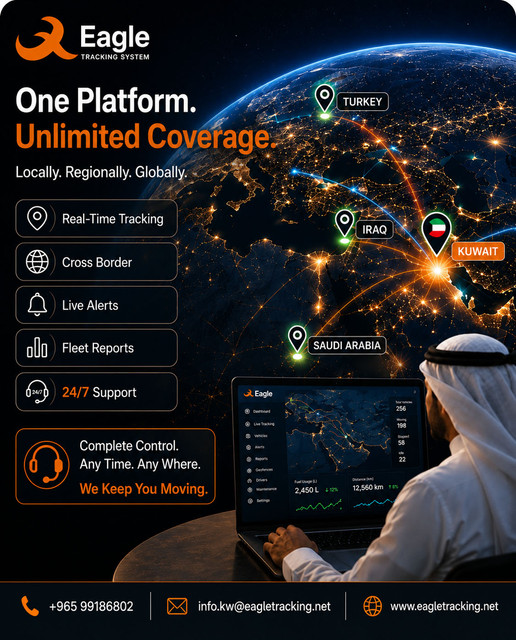
Harsh braking, speeding, and aggressive acceleration don’t just raise accident risk; they accelerate tire wear, increase fuel burn, and shorten the lifespan of brake systems and transmissions. Telematics platforms that score driver behavior give fleet managers a tool to coach individual drivers rather than guess who needs attention. Companies that have rolled out driver scoring across their Gulf fleets frequently see accident rates drop within months, alongside a noticeable reduction in fuel consumption, since smoother driving habits use measurably less diesel per kilometer.
Compliance Without the Paperwork Headache
Cross-border trucking between Gulf states, or transport corridors linking Egypt, Tunisia, and Morocco, involves a tangle of rules around driving hours, vehicle weight limits, and border d*ocumentation. Manual compliance vehicle tracking solutions invites costly mistakes: a driver exceeding permitted hours, an overloaded trailer flagged at a checkpoint, a missed customs window. Integrated fleet systems flag these issues before they become fines or delays, giving logistics managers a tool that quietly protects revenue while keeping the company in good standing with transport authorities across multiple jurisdictions.
Scaling Without Losing Control
Growth is where many logistics companies stumble. Adding trucks and drivers without expanding visibility creates a management gap that often shows up first in customer complaints and missed deliveries. Fleet technology scales in a way human oversight cannot; a system monitoring ten vehicles handles a hundred with the same consistency, freeing managers to focus on growing the client b*ase rather than chasing down where each truck happens to be at any given hour.
Technology as the New Cost of Entry
The logistics companies thriving across the Gulf and North Africa today share one trait: they treat fleet technology not as an add-on but as the framework their entire business runs on. Those still relying on instinct and phone calls aren’t necessarily doing anything wrong by old standards; they’re simply playing a different game than their competitors, one with slower information and higher hidden costs. As client expectations keep rising, the gap between tracked and untracked fleets will only widen, and closing that gap sooner rather than later tends to be far less costly than catching up after losing contracts to better-equipped rivals.
Compliance Without the Paperwork Headache
Cross-border trucking between Gulf states, or transport corridors linking Egypt, Tunisia, and Morocco, involves a tangle of rules around driving hours, vehicle weight limits, and border d*ocumentation. Manual compliance vehicle tracking solutions invites costly mistakes: a driver exceeding permitted hours, an overloaded trailer flagged at a checkpoint, a missed customs window. Integrated fleet systems flag these issues before they become fines or delays, giving logistics managers a tool that quietly protects revenue while keeping the company in good standing with transport authorities across multiple jurisdictions.
Scaling Without Losing Control
Growth is where many logistics companies stumble. Adding trucks and drivers without expanding visibility creates a management gap that often shows up first in customer complaints and missed deliveries. Fleet technology scales in a way human oversight cannot; a system monitoring ten vehicles handles a hundred with the same consistency, freeing managers to focus on growing the client b*ase rather than chasing down where each truck happens to be at any given hour.
Technology as the New Cost of Entry
The logistics companies thriving across the Gulf and North Africa today share one trait: they treat fleet technology not as an add-on but as the framework their entire business runs on. Those still relying on instinct and phone calls aren’t necessarily doing anything wrong by old standards; they’re simply playing a different game than their competitors, one with slower information and higher hidden costs. As client expectations keep rising, the gap between tracked and untracked fleets will only widen, and closing that gap sooner rather than later tends to be far less costly than catching up after losing contracts to better-equipped rivals.